A Patriot's History of the United States by Larry Schweikart & Michael Allen
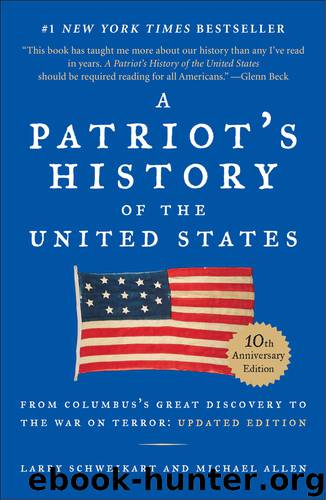
Author:Larry Schweikart & Michael Allen [Schweikart, Larry]
Language: eng
Format: epub
ISBN: 9780698173637
Publisher: Penguin Publishing Group
Published: 2014-11-25T05:00:00+00:00
Roosevelt had succeeded at everything he ever attempted—improving his physical strength and athletic prowess, courting and winning his wife, leading men in combat, and running for office.
By the time he became president then, Theodore Roosevelt had prepared himself for the office in every aspect necessary to the job, save one: understanding capitalism, private enterprise, and the industrial nature of modern America. For someone steeped in the romantic images of the West, Roosevelt should have favored the “rugged individualism” of a Carnegie, but his reform impulse possessed him. As a result, he became the most activist president since Andrew Jackson, doing more to impede business than any president since Old Hickory.
Trust-busting, Business Bashing
An indication of where Roosevelt planned to go with his agenda of corporate regulation could be gleaned from his brief stint as New York governor, where he pushed through a measure taxing corporations. A social Darwinist, Roosevelt liked the notion that there existed an intellectual hierarchy among men, and that only the “best and the brightest” should lead. This same Roosevelt fancied himself the friend of the oppressed and thought farmers, mechanics, and small business owners were his “natural allies.”57 But in Roosevelt’s mind, if the brilliant individual or the visionary man knew best how to reform society, he should do so with whatever tools he had at his disposal, including government. Consequently, it surprised no one who knew him that Roosevelt favored an activist federal presence. William Howard Taft said that he never met a man “more strongly in favor of strong government” than Roosevelt.58
In his first inaugural, Roosevelt spoke favorably of great corporations and endorsed the idea of expanding markets. To this he added that trusts had gone beyond the capacity of existing laws to deal with them, and that old laws and traditions could not sufficiently contain concentrations of wealth and power. Congress sensed the change, passing the Elkins Act in 1903, which prohibited railroads from giving rebates—essentially volume discounts—to large corporations. The notion that businesses were different from individual behavior, or needed to be penalized for success beyond what was “reasonable,” was a Progressive principle that soon emerged in many regulations.
Epitomizing the direction of Roosevelt’s new policies was the Northern Securities suit of 1902. This followed a legal ruling in the E. C. Knight sugar refiner case of 1895, where the Supreme Court declared the regulation of manufacturing a state responsibility; since the manufacturing was within a state’s boundaries, any successful suit had to involve interstate commerce. Since Northern Securities involved railroads crossing state lines, it met the requirements. Roosevelt thought he had an opening, and instructed the attorney general, Philander C. Knox, to file a Sherman antitrust suit against Northern Securities, a holding company for the Northern Pacific, Great Northern, and Chicago, Burlington, and Quincy railroads. J. P. Morgan, James J. Hill, E. H. Harriman, and representatives of Standard Oil Company had combined the northwestern railroad lines into Northern Securities, a single holding company worth $400 million. What made the Northern Securities suit different
Download
This site does not store any files on its server. We only index and link to content provided by other sites. Please contact the content providers to delete copyright contents if any and email us, we'll remove relevant links or contents immediately.
| Africa | Americas |
| Arctic & Antarctica | Asia |
| Australia & Oceania | Europe |
| Middle East | Russia |
| United States | World |
| Ancient Civilizations | Military |
| Historical Study & Educational Resources |
Cat's cradle by Kurt Vonnegut(15446)
Pimp by Iceberg Slim(14680)
4 3 2 1: A Novel by Paul Auster(12519)
Underground: A Human History of the Worlds Beneath Our Feet by Will Hunt(12146)
The Radium Girls by Kate Moore(12096)
Wiseguy by Nicholas Pileggi(5843)
The Fire Next Time by James Baldwin(5508)
Perfect Rhythm by Jae(5471)
American History Stories, Volume III (Yesterday's Classics) by Pratt Mara L(5339)
Paper Towns by Green John(5248)
Pale Blue Dot by Carl Sagan(5083)
A Higher Loyalty: Truth, Lies, and Leadership by James Comey(5020)
The Doomsday Machine by Daniel Ellsberg(4557)
The Mayflower and the Pilgrims' New World by Nathaniel Philbrick(4541)
Killers of the Flower Moon: The Osage Murders and the Birth of the FBI by David Grann(4490)
The Sympathizer by Viet Thanh Nguyen(4447)
Too Much and Not the Mood by Durga Chew-Bose(4390)
The Borden Murders by Sarah Miller(4384)
Sticky Fingers by Joe Hagan(4257)
